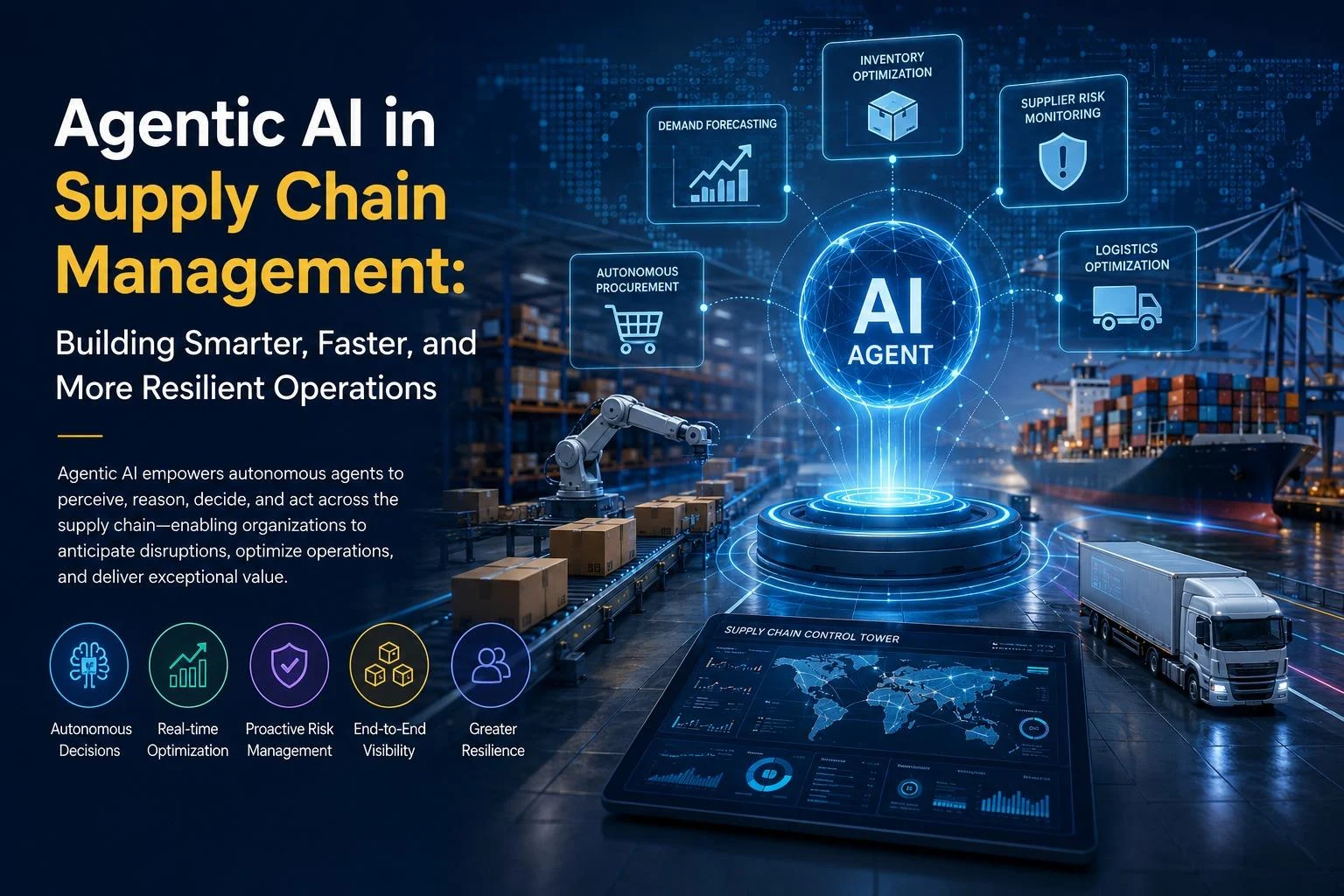
Modern supply chains face constant disruption. Demand fluctuations, supplier delays, inventory shortages, transportation bottlenecks, and geopolitical uncertainty make planning more difficult than ever.
While traditional AI helps organizations analyze data and generate forecasts, it still relies heavily on human intervention for decision-making. Agentic AI changes this model by enabling intelligent agents to analyze situations, make decisions, and execute actions autonomously.
From procurement and inventory management to logistics and risk mitigation, Agentic AI is helping enterprises move toward autonomous supply chains that can adapt in real time.
What Is Agentic AI in Supply Chain Management?
Agentic AI refers to AI systems capable of understanding goals, reasoning through complex scenarios, making decisions, and taking actions with minimal human involvement.
Unlike traditional AI systems that provide recommendations, AI agents can execute workflows across multiple systems and continuously adapt based on changing conditions.
For example, if a critical supplier experiences delays, an AI agent can:
- Detect the disruption
- Analyze inventory impact
- Identify alternative suppliers
- Compare costs and lead times
- Update procurement plans
- Notify stakeholders
Instead of waiting for teams to manually coordinate these tasks, the agent manages the process end-to-end.
This ability to perceive, reason, act, and learn makes Agentic AI particularly valuable for supply chain environments where speed and accuracy directly impact business outcomes.
Why Traditional Supply Chains Need a New Approach
Supply chains have become significantly more complex over the last decade.
Organizations now manage:
- Global supplier networks
- Multi-location warehouses
- Omnichannel fulfillment
- Dynamic customer demand
- Regulatory requirements
- Sustainability targets
Despite investments in ERP, WMS, and transportation management systems, many processes remain reactive.
Common challenges include:
Limited Visibility
Data often exists across disconnected systems, making it difficult to gain a real-time view of operations.
Slow Decision-Making
Critical decisions frequently require multiple teams, resulting in delays during disruptions.
Forecasting Inaccuracies
Traditional forecasting models struggle to account for rapidly changing market conditions.
Inventory Imbalances
Businesses often experience excess inventory in one location and shortages in another.
Agentic AI addresses these challenges by continuously monitoring supply chain conditions and taking corrective action when needed.
How Agentic AI Works in Supply Chain Operations
Agentic supply chains typically consist of multiple AI agents working together.
Data Intelligence Layer
Agents gather information from:
- ERP platforms
- Warehouse systems
- Transportation systems
- Supplier portals
- IoT sensors
- Market intelligence tools
Reasoning Layer
The agents analyze:
- Demand signals
- Inventory levels
- Transportation constraints
- Supplier performance
- Cost fluctuations
Decision Layer
Based on predefined goals and business rules, agents evaluate multiple scenarios and determine optimal actions.
Execution Layer
The agents can then:
- Create purchase orders
- Reallocate inventory
- Reschedule shipments
- Adjust production plans
- Trigger alerts and approvals
This creates a closed-loop system where decisions and actions happen continuously.
Agentic AI vs Traditional AI in Supply Chain Management
While both Agentic AI and traditional AI help organizations improve supply chain performance, they differ significantly in how they operate. Traditional AI focuses on analyzing data, identifying patterns, and generating recommendations that require human review and action. Agentic AI goes a step further by autonomously making decisions and executing tasks based on predefined goals, business rules, and real-time conditions.
In supply chain environments where delays can lead to increased costs, inventory shortages, or missed customer expectations, the ability to act without waiting for manual intervention can provide a significant advantage. Agentic AI enables organizations to move from reactive decision-making to proactive and autonomous operations.
| Feature | Traditional AI | Agentic AI |
| Primary Function | Provides insights and recommendations | Makes decisions and executes actions |
| Human Involvement | High | Minimal to moderate |
| Decision-Making | Requires human approval | Can operate autonomously within defined rules |
| Response to Disruptions | Identifies potential issues | Detects, analyzes, and resolves issues automatically |
| Workflow Execution | Limited | End-to-end automation across systems |
| Adaptability | Relies on predefined models | Continuously learns and adapts to changing conditions |
| Inventory Management | Forecasts inventory needs | Automatically adjusts replenishment and allocation strategies |
| Procurement Support | Suggests supplier options | Evaluates suppliers and initiates procurement workflows |
| Logistics Optimization | Recommends route improvements | Dynamically adjusts routes and shipment plans in real time |
| Operational Efficiency | Improves decision support | Drives autonomous supply chain operations |
As supply chains become increasingly complex, organizations are looking beyond predictive analytics and automation toward systems that can independently coordinate activities across procurement, inventory management, logistics, and fulfillment. Agentic AI represents the next evolution of supply chain intelligence by combining advanced reasoning, real-time decision-making, and autonomous execution to create more agile and resilient operations.
Key Use Cases of Agentic AI in Supply Chains
1. Autonomous Demand Forecasting
Demand forecasting often becomes outdated quickly due to changing customer behavior.
Agentic AI continuously analyzes:
- Historical sales data
- Seasonal patterns
- Market conditions
- Customer trends
This allows forecasts to update dynamically and improve planning accuracy.
2. Intelligent Procurement
Procurement agents monitor supplier performance, pricing changes, and lead times.
When risks emerge, agents can automatically:
- Identify alternative vendors
- Generate RFQs
- Evaluate supplier options
- Recommend sourcing decisions
This reduces procurement delays and improves resilience.
3. Inventory Optimization
Maintaining optimal inventory levels remains one of the biggest supply chain challenges.
AI agents can:
- Monitor stock levels across locations
- Predict stockout risks
- Recommend replenishment actions
- Optimize safety stock
The result is improved service levels with lower carrying costs.
4. Logistics and Route Optimization
Transportation costs continue to rise globally.
Agentic AI helps organizations:
- Optimize delivery routes
- Select carriers
- Reduce fuel consumption
- Minimize transit delays
Real-time adjustments help improve delivery performance while reducing operational expenses.
5. Supply Chain Risk Management
Supply chain disruptions can emerge from numerous sources, including weather events, labor shortages, political instability, and supplier failures.
Risk intelligence agents continuously monitor these signals and proactively recommend mitigation strategies before disruptions impact operations.
6. Warehouse Operations Automation
Warehouse agents support:
- Labor allocation
- Picking optimization
- Slotting strategies
- Capacity planning
This improves throughput while reducing operational bottlenecks.
7. Predictive Maintenance
Equipment failures can significantly disrupt production schedules.
By monitoring sensor data and machine performance, AI agents can identify maintenance requirements before breakdowns occur.
This reduces downtime and extends asset life.
Benefits of Agentic AI for Enterprises
Faster Decision-Making
AI agents operate continuously and respond instantly to changing conditions.
Improved Forecast Accuracy
Real-time demand sensing enables more accurate planning.
Reduced Operational Costs
Automation reduces manual effort and improves resource utilization.
Enhanced Supply Chain Resilience
Organizations can identify and respond to disruptions earlier.
Better Customer Experience
Improved inventory availability and delivery performance contribute to higher customer satisfaction.
End-to-End Visibility
Agentic systems create a connected view across procurement, manufacturing, logistics, and fulfillment.
Why Businesses Are Investing in Agentic AI
Organizations are investing in Agentic AI to build more agile, efficient, and resilient supply chains capable of responding to disruptions in real time. Unlike traditional automation tools that depend on predefined rules and human intervention, Agentic AI can analyze changing conditions, make decisions, and execute actions across procurement, inventory management, logistics, and fulfillment processes.
Industry research highlights the growing business interest in AI-driven supply chain transformation. According to McKinsey, companies implementing autonomous supply chain planning have achieved inventory reductions of up to 20%, supply chain cost reductions of up to 10%, and revenue improvements of up to 4% through better planning and operational efficiency.
The momentum behind AI adoption continues to accelerate. A 2026 report from MHI and Deloitte found that 71% of supply chain leaders believe AI is already disrupting supply chains, with nearly a quarter describing its impact as transformational. The report identifies AI as the most disruptive supply chain technology expected to shape operations over the next decade.
Beyond cost savings, businesses are adopting Agentic AI to improve forecasting accuracy, optimize inventory allocation, strengthen supplier management, reduce operational risks, and enhance customer service. As supply chains become more complex and interconnected, Agentic AI is emerging as a key technology for organizations seeking a competitive advantage through faster decision-making and greater operational resilience.
Challenges and Implementation Considerations
While the benefits are substantial, organizations should address several challenges before deploying Agentic AI.
Data Quality
AI agents depend on accurate and timely data.
Poor-quality information can lead to poor decisions.
Legacy System Integration
Many organizations operate across multiple disconnected systems.
Successful implementation requires seamless integration between enterprise applications.
Governance and Oversight
Not every decision should be fully autonomous.
Organizations need clear policies defining:
- Approval thresholds
- Risk controls
- Human intervention requirements
Security and Compliance
AI agents often interact with critical business systems.
Strong access controls and governance frameworks are essential.
Organizational Readiness
Employees must understand how AI agents support their work rather than replace it.
Successful adoption requires change management and training initiatives.
The Future of Autonomous Supply Chains
The next generation of supply chains will move beyond automation toward autonomy.
Future supply chain ecosystems will include specialized AI agents capable of:
- Negotiating with suppliers
- Managing procurement workflows
- Optimizing inventory allocation
- Coordinating transportation networks
- Predicting disruptions
- Executing mitigation plans automatically
Combined with digital twins, IoT platforms, and real-time analytics, Agentic AI will enable self-learning and self-optimizing supply chains.
Organizations that adopt these technologies early will gain significant advantages in operational efficiency, resilience, and customer service.
FAQs
Agentic AI in Supply Chain Management refers to intelligent AI agents that can analyze data, make decisions, and execute actions across supply chain processes with minimal human intervention. These systems help automate forecasting, procurement, inventory management, logistics, and risk mitigation.
Traditional AI primarily provides insights, predictions, and recommendations, while Agentic AI can take autonomous actions based on predefined goals. It can coordinate workflows, respond to disruptions, and continuously adapt to changing supply chain conditions.
Agentic AI helps organizations improve forecasting accuracy, optimize inventory levels, reduce operational costs, enhance supply chain visibility, respond faster to disruptions, and improve overall operational efficiency.
Agentic AI continuously analyzes historical sales data, customer behavior, market trends, seasonal patterns, and external factors to generate dynamic forecasts that update in real time as conditions change.
Yes. Agentic AI can monitor supplier performance, transportation networks, weather conditions, market events, and other risk factors to identify potential disruptions early and recommend or execute corrective actions.
Agentic AI tracks inventory levels across multiple locations, predicts stock shortages or excess inventory, recommends replenishment strategies, and helps maintain optimal stock levels to improve service performance while reducing carrying costs.
Industries such as manufacturing, retail, e-commerce, healthcare, automotive, consumer goods, logistics, and food distribution can benefit from Agentic AI by improving supply chain agility, efficiency, and resilience.
Agentic AI is powered by technologies such as machine learning, large language models (LLMs), predictive analytics, digital twins, Internet of Things (IoT) devices, robotic process automation (RPA), and real-time data platforms.
Organizations should address data quality, system integration, cybersecurity, governance policies, compliance requirements, and workforce readiness to ensure successful Agentic AI adoption and long-term value.
The future of Agentic AI involves increasingly autonomous supply chains where AI agents can coordinate procurement, inventory allocation, logistics planning, supplier collaboration, and risk management in real time, helping businesses build more efficient and resilient operations.
Final Thoughts
Supply chains are becoming more complex, interconnected, and dynamic. Traditional planning methods and rule-based automation struggle to keep pace with modern business demands.
Agentic AI in Supply Chain Management introduces a new operating model where intelligent agents can monitor conditions, make decisions, and execute actions across procurement, inventory, logistics, and fulfillment processes with minimal human intervention.
From procurement and inventory management to logistics optimization and risk mitigation, Agentic AI in Supply Chain Management is laying the foundation for autonomous supply chains that are faster, smarter, and more resilient.
As organizations continue investing in AI-driven transformation, Agentic AI in Supply Chain Management will play a critical role in improving operational efficiency, strengthening supply chain resilience, and enabling real-time decision-making across increasingly complex global networks.