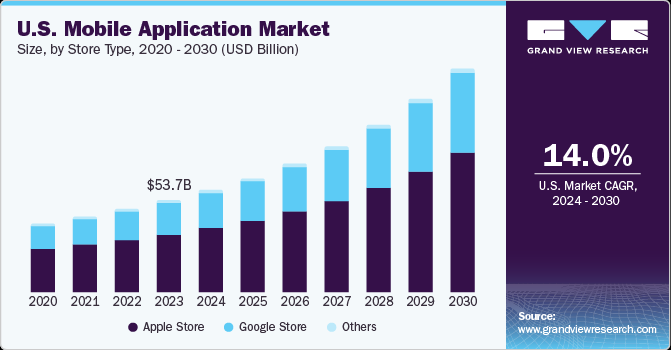
The U.S. mobile application market was valued at an estimated $59.66 billion in 2024 and is projected to reach $131.05 billion by 2030, growing at a 14.0% CAGR, according to Grand View Research. Its latest 2026 market analysis projects the U.S. mobile application market to grow at 15.3% annually from 2026 to 2033, making the country one of the largest markets for mobile applications.
For businesses planning a new mobile product, the development partner matters as much as the idea itself. The right company depends on the app’s features, target platforms, industry requirements, technical complexity, budget and support needed after launch. Based on company history, published projects, technical capabilities, industries served and available third-party information, this list includes Nyusoft Solutions, Goji Labs, Atomic Object, Designli, Chop Dawg, Fueled, Thoughtbot, and AppMakers USA.
The companies below are compared on practical factors such as years of experience, app development services, technologies, industries, project experience, engagement models and suitability for different types of applications. The list is an editorial comparison rather than an official industry ranking, so readers can use it as a starting point when shortlisting a development partner.
List Of Top 8 App Development Companies In USA
| Rank | Company | Founded | Location | Best For |
| 1 | Nyusoft Solutions | 2012 | USA, India & Australia | Custom apps, SaaS and business applications |
| 2 | Goji Labs | 2014 | Los Angeles, California | Startups, SMBs and digital products |
| 3 | Atomic Object | 2001 | Michigan & other US locations | Complex custom software and mobile applications |
| 4 | Designli | 2013 | Greenville, South Carolina | Startups and MVP development |
| 5 | Chop Dawg | 2009 | Philadelphia, Pennsylvania | Full-service app and product development |
| 6 | Fueled | 2007 | New York, New York | Consumer apps and design-focused products |
| 7 | thoughtbot | 2003 | USA, with multiple locations | Product strategy and custom software |
| 8 | AppMakers USA | 2014 | Santa Monica, California | Mobile apps and startup products |
1. Nyusoft Solutions
Founded in 2012, Nyusoft Solutions is a software development company that works on mobile applications, web applications, SaaS products, enterprise software, AI, IoT and UI/UX.
The company states that it has 13+ years of software development experience and has completed 850+ projects. It has a presence across India, the USA, and Australia.
Its development work covers both the application users see and the software that supports it behind the scenes. That can include mobile apps, APIs, databases, cloud infrastructure, admin panels and third-party integrations.
App development services
Nyusoft’s mobile development capabilities include:
- iOS app development
- Android app development
- React Native development
- Flutter development
- Ionic development
- Cross-platform application development
- Custom mobile applications
- UI/UX design
- API development and integration
- Application testing
- App maintenance and support
The company also works on web applications, SaaS products, enterprise software, AI and Generative AI solutions, and IoT applications.
Industries served
Its published industry areas include:
- FinTech
- EdTech
- Healthcare and wellness
- Fitness
- Real estate
- Staffing and recruitment
- Travel
- Sports
- Career platforms
- Marketplaces
- On-demand services
This variety matters for companies developing specialised applications. A financial application, for example, has different requirements from a fitness application or a property marketplace.
Published project experience
Nyusoft publishes case studies covering different types of software products.
One example is WorknStay, a property rental and accommodation platform developed for web, iOS and Android. The documented technology stack includes Angular, Node.js and Kotlin, with features such as property search, booking, chat, availability and payments.
The company also publishes projects involving marketplaces, education, finance, healthcare, e-commerce and other business applications.
Engagement models
Different development projects need different working arrangements. Nyusoft lists several engagement options, including:
- Staff augmentation
- Time and material
- Agile/Pod-based development
Staff augmentation can suit a business that already has a product team but needs additional developers. A time-and-material arrangement can be useful when the scope may change during development. A dedicated Agile team can be suitable for a product that will continue through several development cycles.
Best suited for
Nyusoft can be considered for:
- Custom mobile applications
- Startup MVPs
- SaaS products
- Marketplace applications
- FinTech applications
- EdTech platforms
- AI-enabled applications
- Enterprise mobile applications
- Mobile and web products
- IoT-connected applications
For a business that needs the mobile application and the supporting software built together, its [mobile app development services] can be reviewed alongside its wider software development capabilities.
2. Goji Labs
Goji Labs was founded in 2014 and is based in Los Angeles, with a New York presence as well.
The company focuses on product strategy, UX/UI design, software engineering, and mobile application development. Its current company information states that it has launched more than 500 products and supported more than 25 million users.
Services
Its services include:
- Mobile app development
- iOS development
- Android development
- Custom software development
- Product strategy
- UX/UI design
- Web application development
- AI product development
- Conversational interfaces
- Workflow automation
Goji Labs lists experience across more than 20 industries, including healthcare, financial services, education, SaaS, retail, government, logistics, real estate, travel and media.
Project experience
The company has published work involving organisations such as the World Health Organization, WWF, Mural and Mitsubishi’s AnyMile.
This makes its portfolio particularly useful for companies that want to see how a development partner has handled different product types before starting a project.
Best suited for
Goji Labs may be a good fit for:
- Funded startups
- Enterprise digital products
- AI-enabled applications
- Healthcare platforms
- FinTech applications
- Products that need strategy, design and development together
Its current Clutch profile lists a minimum project size of $50,000 and an hourly range of $150 to $199.
3. Atomic Object
Atomic Object has been developing custom software since 2001. The company is employee-owned and has offices in Ann Arbor, Chicago, Grand Rapids and Raleigh-Durham.
Its work goes beyond mobile applications. The company develops web, desktop, cloud and connected-device software as well.
Mobile development capabilities
Atomic Object works with:
- iOS
- Android
- React Native
- Cloud platforms
- IoT systems
- Bluetooth and connected devices
- Enterprise software
Its mobile work includes both native and cross-platform development.
Industry experience
Published work covers areas such as:
- Healthcare
- Insurance
- Finance
- Manufacturing
- Government
- Energy
- Industrial software
One published example is its work for Origami Risk. Atomic Object rebuilt the company’s mobile application using React Native for iOS and Android, including offline functionality and dynamic forms.
Best suited for
Atomic Object is worth considering for:
- Complex software products
- Enterprise applications
- Healthcare technology
- IoT products
- Industrial applications
- Connected-device software
- Products that require mobile and backend engineering
Its current Clutch listing shows a minimum project size of $25,000 and an hourly range of $150 to $199.
4. Designli
Designli is based in Greenville, South Carolina, and focuses on product strategy, design and software development.
The company has particular experience working with startups and businesses that need to take an idea from an early product concept through design and development.
Services
Designli provides:
- Mobile app development
- React Native development
- MVP development
- SaaS development
- UX/UI design
- Product strategy
- Custom software development
- Web application development
- AI implementation
Its published technology information includes React Native, Node.js, NestJS and AWS.
Project experience
Its portfolio includes products in areas such as:
- Education
- Financial services
- Logistics
- Field services
- SaaS
- Marketplaces
- Healthcare
Published examples include Virtuosity, an education and coaching application, and Secur.Space, a logistics marketplace.
Best suited for
Designli may be a suitable option for:
- Startup founders
- MVP development
- SaaS products
- Cross-platform applications
- Businesses that need product design and development together
Its current Clutch profile lists a minimum project size of $10,000 and an hourly range of $50 to $99.
5. Chop Dawg
Chop Dawg was founded in 2009 and is based in Philadelphia.
The company focuses heavily on mobile applications and also develops web applications, custom software and products that connect mobile applications with external systems or hardware.
Services
Its capabilities include:
- iOS development
- Android development
- Web application development
- UI/UX design
- Custom software development
- AI applications
- Hardware integrations
- Bluetooth integrations
- Maintenance and support
Project examples
One published example is the Mister Softee mobile application. The project included iOS and Android applications connected to a franchise backend, with features covering truck locations, menus, push notifications, event bookings and analytics.
The company also publishes work involving fitness, EV charging, employee engagement and restaurant applications.
Pricing
Chop Dawg publishes its own project cost ranges. It states that focused products can start around $25,000, while larger projects involving mobile apps, web applications, marketing sites and administrative dashboards can reach $75,000 to $150,000. Some larger projects have exceeded $750,000.
These are company-specific figures rather than a standard cost for US app development.
Best suited for
Chop Dawg may suit:
- Startup applications
- Consumer apps
- iOS and Android projects
- Government projects
- Education applications
- Hardware-connected apps
- Products that need ongoing development
Its current Clutch listing shows an $1,000+ minimum project size and an hourly range of $50 to $99.
6. Fueled
Fueled was founded in 2007 and is based in New York.
The company works across product strategy, design, engineering and mobile application development. Its current company information states that it has more than 300 experts.
Services
Its capabilities include:
- Mobile application development
- Product strategy
- UX/UI design
- Web development
- AI implementation
- Cloud management
- DevOps
- Infrastructure
The company lists experience in financial services, healthcare, retail, travel and hospitality, higher education, government, media and technology startups.
Best suited for
Fueled is more relevant to organisations that need a broader product team rather than development alone.
It can be considered for:
- Consumer applications
- Enterprise products
- Mobile products
- Digital product redesigns
- Companies needing strategy, design and engineering
Its current Clutch profile lists a minimum project size of $75,000 and an hourly range of $150 to $199.
7. Thoughtbot
Thoughtbot was founded in 2003 and has worked with more than 1,000 clients across product strategy, design and software development.
The company works with startups as well as established organisations and provides services throughout the product lifecycle.
Mobile development
Its mobile development services include:
- iOS development
- Android development
- React Native development
- Product design
- Product strategy
- Web development
- DevOps
- Cloud
- CI/CD
It has published work across healthcare, finance, insurance and government.
Native or cross-platform?
One useful part of Thoughtbot’s technical guidance is its discussion of when native development makes sense and when React Native can be a better option.
For example, Swift can be used for native iOS development and Kotlin for Android. React Native can make sense when a product needs applications on both platforms while sharing a substantial portion of its code.
The decision should depend on the product rather than simply following whichever framework is currently popular.
Published work
Its portfolio includes mobile work for Harvard Business Review, Airrosti Remote Recovery, Groups Recover Together and other organisations.
Best suited for
Thoughtbot may be suitable for:
- Startups
- MVPs
- Existing products that need improvement
- React Native projects
- Product strategy and development
- Teams that need design and engineering support
8. AppMakers USA
AppMakers USA is based in Los Angeles and focuses on mobile applications, AI development, custom software and UX/UI design.
Its current Clutch profile lists 50 to 249 employees, a $10,000+ minimum project size, and an hourly range of $100 to $149.
Services
Its listed services include:
- iOS development
- Android development
- AI development
- Custom software development
- UX/UI design
- Web development
The company has also received recent verified client reviews on Clutch covering mobile development and related services.
Best suited for
AppMakers USA can be considered by companies looking for:
- iOS applications
- Android applications
- AI-enabled apps
- Custom software
- Mobile products with UX/UI requirements
For a large project, it is still worth asking for recent examples that match the intended industry, user base, and technical requirements.
How Much Does App Development Cost in the USA?
The cost of developing a mobile app in the USA generally depends on the app’s complexity, features, platforms, integrations, and development team.
| App Type | Estimated Development Cost |
| Basic app | $10,000 – $25,000 |
| Medium-complexity app | $25,000 – $60,000 |
| Advanced app | $60,000 – $100,000+ |
| Marketplace / SaaS app | $75,000 – $150,000+ |
| Enterprise / FinTech / Healthcare app | $100,000 – $250,000+ |
| Complex AI or large-scale platform | $200,000+ |
These are practical planning ranges, not fixed market prices. Current Clutch data shows that many mobile app projects fall within the $10,000 to $49,999 range, while larger projects can cost considerably more.
The final cost is mainly affected by number of platforms, features, UI/UX, backend development, integrations, security, AI functionality, testing, and ongoing maintenance.
For most businesses, defining the required features before requesting quotes is the best way to get comparable estimates.
Native vs Cross-Platform App Development
The choice between native and cross-platform development affects the way an application is built and maintained.
Native development
Native development means building separately for each mobile operating system.
For example:
- Swift is commonly used for iOS
- Kotlin is commonly used for Android
Native development can make sense when the application requires deep platform integration, specialised device features, advanced graphics or highly platform-specific behaviour.
Cross-platform development
Frameworks such as React Native and Flutter allow developers to share a larger part of the code between iOS and Android.
This can reduce duplicated development work, particularly when both platforms need to be released around the same time.
There are trade-offs, though. Some features still need platform-specific code, and certain products may benefit from completely native development.
The better question is not which technology is universally better. It is which approach fits the product’s features, budget, development team and long-term plans.
What to Check Before Hiring an App Development Company
A company’s website can tell you what services it offers. It cannot tell you everything about how your project will actually be handled.
Look at relevant projects
Do not judge a company only by the number of apps in its portfolio.
Look for projects similar to yours.
A healthcare application may require experience with sensitive data and healthcare workflows. A marketplace needs different capabilities, including vendor management, payments and search. A FinTech product may require financial integrations and stronger security controls.
Relevant experience is more useful than a long list of unrelated projects.
Find out who will work on the project
Ask for the proposed team before signing.
Find out whether the project will have:
- A project manager
- Product manager
- UI/UX designer
- Mobile developers
- Backend developers
- QA engineers
- DevOps or cloud specialists
Also ask where the team is located and how communication will work.
Ask about post-launch support
The first release is not the end of mobile app development.
Operating systems change. APIs change. Security problems appear. Users request new features.
Ask whether the development agreement covers:
- Bug fixing
- OS updates
- Security updates
- App Store and Google Play updates
- Performance improvements
- Cloud monitoring
- New features
- Technical support
Clarify ownership
The contract should clearly state who owns:
- Source code
- UI designs
- Database
- APIs
- Documentation
- Cloud accounts
- App Store account
- Google Play account
- Intellectual property
This becomes particularly important if the business eventually decides to move development to another team.
Common Mistakes When Choosing an App Development Company
Choosing the cheapest proposal
Price matters, but the cheapest proposal is not necessarily the lowest-cost project.
A proposal may exclude UX design, testing, cloud infrastructure or maintenance. Those costs can appear later.
Compare the complete scope before comparing prices.
Looking only at ratings
A high rating can be useful, but individual reviews tell you more.
Look for reviews involving projects of a similar size and technical complexity. Check what clients actually mention about communication, delivery, technical work and project management.
Forgetting about backend development
The mobile application is often only one part of the product.
A complete system may also require:
- APIs
- Database
- Admin dashboard
- Authentication
- Cloud infrastructure
- Analytics
- Payment integration
- Third-party services
These requirements should be discussed before the development estimate is prepared.
Trying to build every feature immediately
A first release does not need every possible feature.
A smaller version can help validate the main product idea before a company spends heavily on secondary features. It can also make testing and user feedback easier.
Hiring without checking industry experience
A development company may have an excellent portfolio but still lack experience with your particular business model.
Before signing, ask for two or three projects that are technically or commercially close to what you are planning.
Which App Development Company Fits Your Project?
There is no single company that suits every type of app.
| Project requirement | Companies worth considering |
| Custom mobile and web application | Nyusoft Solutions, Atomic Object, Goji Labs |
| Startup or MVP | Nyusoft Solutions, Designli, thoughtbot |
| Complex enterprise software | Atomic Object, Goji Labs, Fueled |
| iOS and Android | Nyusoft Solutions, Goji Labs, Chop Dawg, thoughtbot |
| React Native development | Nyusoft Solutions, Atomic Object, Designli, thoughtbot |
| FinTech applications | Nyusoft Solutions, Goji Labs, thoughtbot |
| Healthcare applications | Atomic Object, Goji Labs, thoughtbot |
| SaaS products | Nyusoft Solutions, Designli, Goji Labs |
| AI-enabled applications | Nyusoft Solutions, Goji Labs, Fueled, AppMakers USA |
| IoT or connected-device applications | Nyusoft Solutions, Atomic Object, Chop Dawg |
| Product strategy plus engineering | Goji Labs, Fueled, thoughtbot, Designli |
This table should be treated as a starting point. The final decision should come from comparing relevant projects, proposed teams, technical plans, communication processes and total project costs.
How to Choose the Right App Development Partner
Start with the product itself.
Write down what the first version needs to do, who will use it, which platforms are required and what systems it needs to connect with. Decide which features are essential for launch and which can wait.
Then ask shortlisted companies to respond to the same requirements.
A useful proposal should explain:
- Development approach
- Technology stack
- Project team
- Milestones
- Testing process
- Delivery assumptions
- Project exclusions
- Estimated timeline
- Payment structure
- Post-launch support
If two proposals have very different prices, ask why. The difference may come from the number of developers, design work, testing, backend development, integrations or support included.
The strongest choice is usually the company that can clearly explain how it would build the product, what it expects from the client, what the quoted price includes and what happens after launch.
A strong portfolio is useful. Relevant experience is better. Clear communication about scope, ownership, cost and technical decisions is what makes the comparison meaningful.